
Write with structure
Chinese Stroke Order: Essential Rules for Better Handwriting
Learn the main Chinese stroke-order rules, understand why order matters, and practise characters with a reliable step-by-step method.
Stroke order is the conventional sequence used to write a Chinese character. Following it helps strokes fit together with more natural proportions and makes repeated handwriting easier to recognize and reproduce.
The rules are patterns, not a substitute for checking an unfamiliar character. Start with the general principles below, then use a trusted animation or model when a character contains an unusual enclosure or crossing structure.
The core stroke-order patterns
- Top before bottom: write the upper part of 二 before the lower part.
- Left before right: write the left component of 你 before the right component.
- Horizontal before vertical when they cross: in 十, write 一 before 丨.
- Outside before inside: begin the outer structure of 同 before its inner component.
- Close a frame last: in 国, write the enclosing final stroke after the inside is complete.
- Center before symmetrical sides: in 小, the central stroke comes before the two side dots.
Why stroke order helps
Correct order encourages consistent spacing because each stroke prepares the position of the next one. It also makes components easier to recognize when you write quickly and supports the flowing connections used in handwritten styles.
For learners, sequence is also a memory tool. Remembering a character as a series of components and movements is usually easier than memorizing a finished square image with no internal plan.
A reliable practice method
- Watch the complete animation once before writing.
- Trace slowly and name the major components rather than counting strokes only.
- Copy the character while the model remains visible.
- Write it once from memory, then compare proportion, direction, and missing strokes.
- Use the character in a word or sentence so handwriting stays connected to language.
Common habits that slow improvement
Drawing the outline of a character, correcting every line repeatedly, or writing many rushed copies can reinforce unstable forms. Use fewer repetitions with clear feedback. If a character looks wrong, identify the component or stroke relationship causing the problem before starting again.
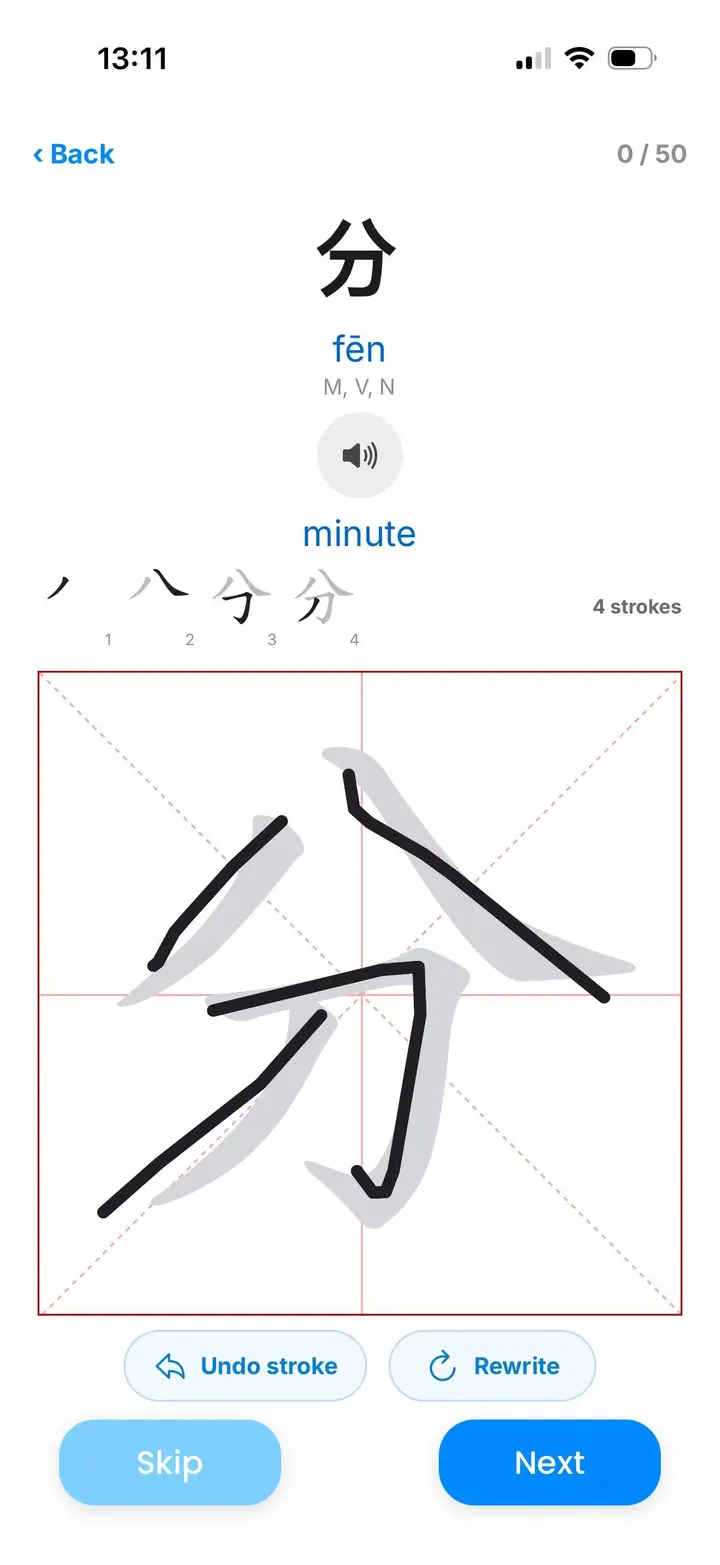
Chivoc handwriting practice shows guided stroke order and character outlines, then lets you compare your writing with the standard form. You can use hints while learning and reduce them as the sequence becomes automatic.