Build every syllable
Pinyin Initials and Finals: How Mandarin Syllables Fit Together
Understand Mandarin pinyin initials, finals, tones, and spelling rules so you can read and pronounce new syllables with confidence.
Most Mandarin syllables can be understood as three parts: an optional initial consonant, a final, and a tone. In mā, m is the initial, a is the final, and the line above a marks the first tone.
Learning these parts as a system is faster than memorizing every written syllable separately. It also explains why some letter combinations are possible in standard pinyin and others are not.
What is a pinyin initial?
An initial is the consonant sound at the beginning of a syllable. Examples include b in bā, m in mā, and h in hǎo. Some syllables, such as ài, begin directly with a final and have no consonant initial.
Several initials need special attention because their pinyin letters do not match their most common English values. The pairs j/q/x, zh/ch/sh, and z/c/s are best learned by listening and comparing tongue position rather than relying on English spelling.
What is a pinyin final?
A final contains the vowel sound and may end with a vowel, -n, -ng, or the special sound written -r in er. Simple finals include a, o, e, i, u, and ü. Compound finals such as ai, ao, iao, and uang combine several movements into one syllable.
Do not pronounce every written vowel as a separate beat. For example, hǎo is one syllable, and the mouth moves smoothly through the final ao.
The spelling rules that confuse beginners
- When i, u, or ü begins a syllable, pinyin often writes y or w to make the syllable boundary clear: i → yi, u → wu, and ü → yu.
- After j, q, and x, the dots on ü are omitted. The u in ju, qu, and xu represents the ü sound.
- The finals iou, uei, and uen are shortened after an initial and written iu, ui, and un.
- The written letter i represents different sounds in syllables such as ji, zhi, and zi. Listen to the complete syllable instead of transferring one English i sound everywhere.
How to practise the system
Choose one initial and combine it with several valid finals: bā, bái, bān, bāng. Then keep the final and change the initial: mā, bá, pà. This reveals the structure while training your ear to separate similar sounds.
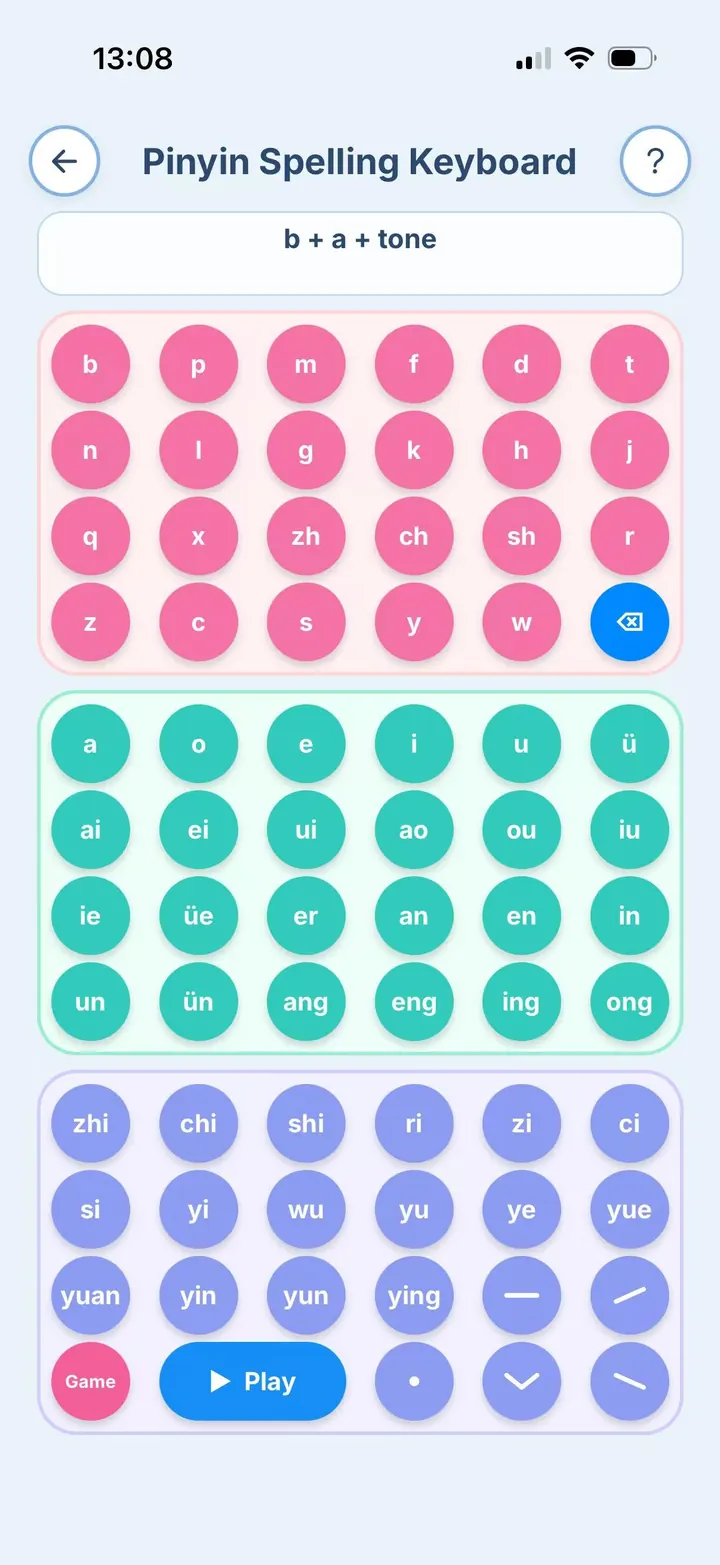
Chivoc’s Pinyin Spelling Keyboard presents initials, finals, whole syllables, and tones as separate controls. The Pinyin Wheel is useful for exploring combinations visually and checking them with audio.